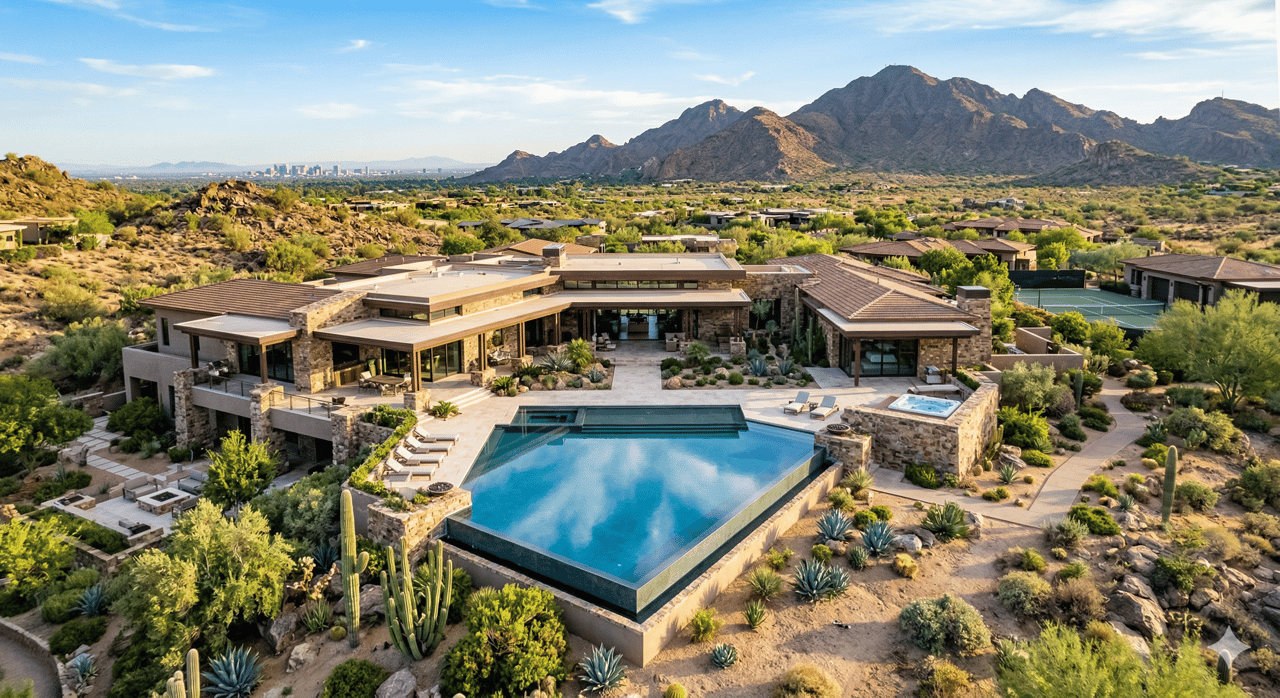
At the $3 million threshold in Scottsdale and Paradise Valley, the mechanics of a transaction shift in ways that most buyers and sellers do not fully anticipate. Cash is not merely a payment method. It is a positioning strategy, a negotiating tool, and increasingly, a baseline expectation among the sellers of significant estates.
March 2026 activity in both markets continues to confirm what our team has observed over multiple cycles: the share of cash transactions at this price point remains elevated well above national norms. Across Scottsdale broadly, cash buyers represent roughly 30 to 35 percent of all sales. In Paradise Valley, where the buyer profile skews toward equity-rich relocators from coastal markets, entrepreneurs, and legacy wealth households, that proportion climbs considerably higher. Local luxury agents across the Valley consistently describe cash as a defining characteristic of high-end PV transactions, and that pattern shows no signs of reversing.
Understanding why matters as much as knowing the numbers.
What Drives the Cash Preference at This Tier
The motivations for cash purchases at $3M and above are layered. For some buyers, it is straightforward liquidity management: they hold sufficient capital and prefer to avoid the time, documentation, and contingency structure that comes with jumbo financing. For others, cash is a deliberate competitive move. In a market where a well-positioned estate can attract multiple qualified parties, eliminating the appraisal contingency and loan approval timeline gives a cash offer a structural advantage that price alone cannot replicate.
There is also the matter of seller psychology. A seller of a $4.5 million estate has generally owned real estate at the highest level for years. They understand deal risk. A financed offer, regardless of the buyer's creditworthiness, introduces variables a cash offer removes entirely. No appraisal gap. No lender delays. No last-minute underwriting conditions. For sellers who have prepared their homes to a high standard and priced accordingly, that simplicity carries real value.
The Jumbo Financing Picture in 2026
For buyers who do intend to finance at this price point, the jumbo market in early 2026 requires careful navigation. Rates have stabilized relative to the volatility of prior years, but jumbo products carry their own qualification standards, documentation expectations, and timeline realities. Buyers entering this tier with financing should expect thorough underwriting, asset verification, and the possibility that unique or architecturally distinctive properties may present appraisal complexity.
For estates with limited comparable sales within a reasonable geographic radius, which describes much of the upper Paradise Valley inventory, financed buyers should proactively engage lenders with proven high-end experience and build appropriate contingency timelines into their offers. A rushed appraisal on a $5 million property rarely benefits the buyer.
What This Means for Sellers
If you are preparing a significant estate for the market this spring, understanding your likely buyer profile shapes every aspect of your strategy. A buyer pool that skews toward cash changes how you structure your timeline, how you evaluate competing offers, and how you think about terms beyond purchase price.
Cash does not always mean the highest offer. But it often means the most certain close, the shortest escrow, and the cleanest path from acceptance to recording. Those variables have real economic value, and sellers who understand them negotiate with greater precision.
Our team works through these considerations with every seller before a listing launches. The goal is never to favor one buyer type over another, but to ensure our clients understand exactly what they are looking at when the offers arrive.