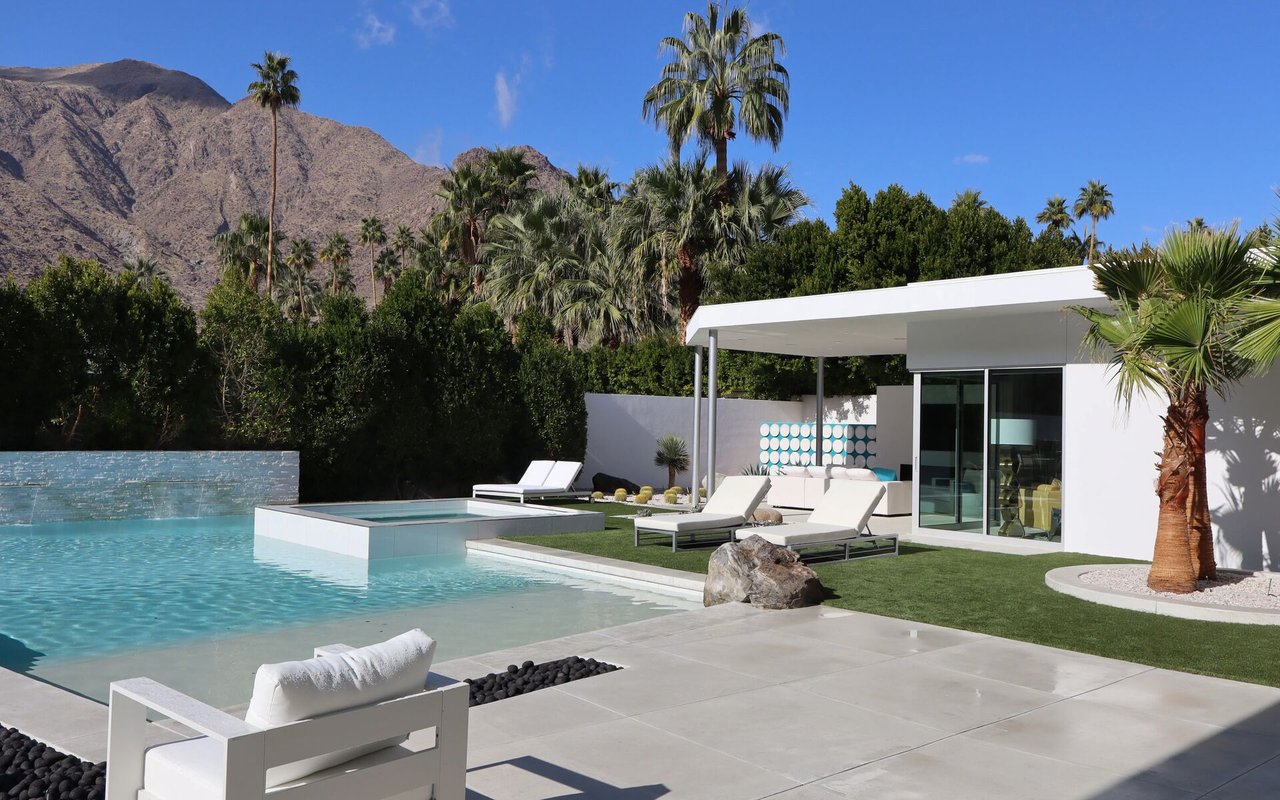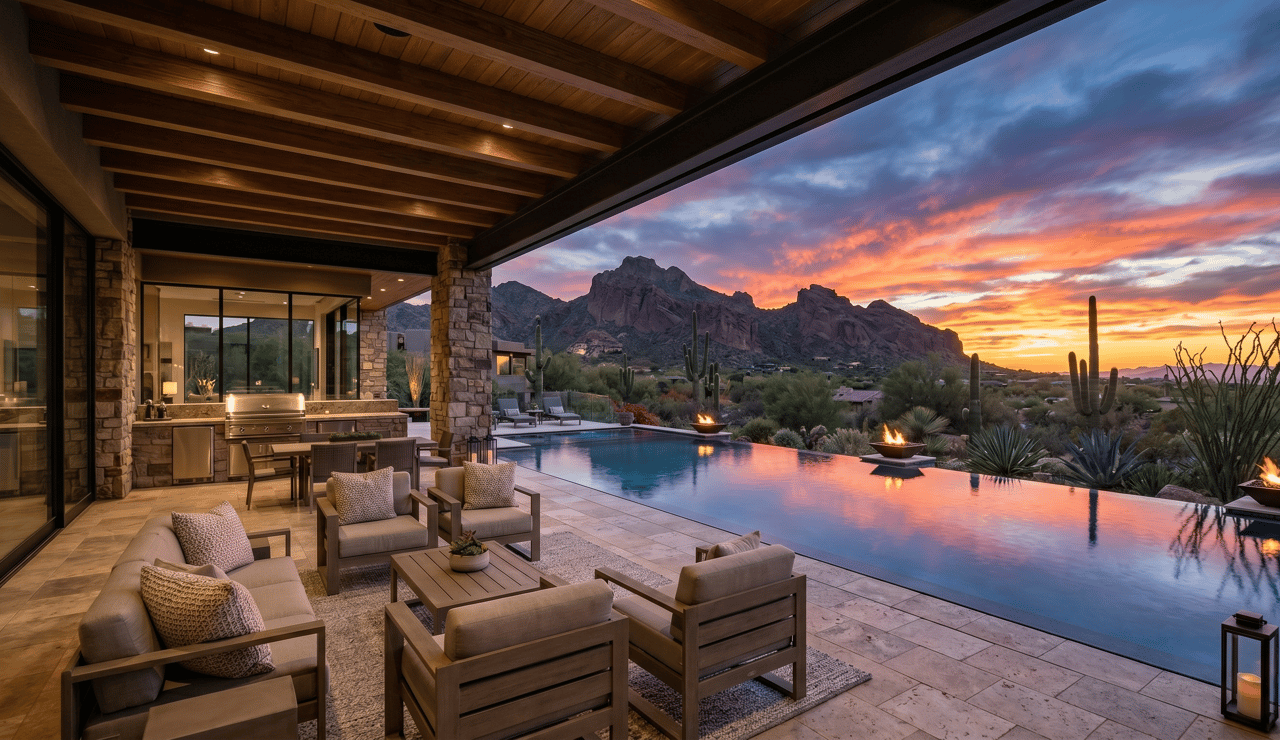
If you are evaluating homes in the $3M+ range in Scottsdale or Paradise Valley, you have almost certainly walked through backyards with elaborate pools, water features, and outdoor entertainment systems priced as premium amenities. Some of them are. Some of them are negotiating leverage waiting to happen.
Knowing the difference before you make an offer is one of the more useful things we can tell you.
Why outdoor features in Scottsdale’s luxury market have very different valuation profiles
What appraisers actually weight when evaluating a pool
A $200,000 pool will not add $200,000 to the appraised value of your home. This is true at nearly every price point in the market. What appraisers weight, and what buyers in subsequent transactions anchor to, is not installation cost. It is condition, integration with the overall design language of the home, and whether the pool reads as a considered feature of the property or a project someone bolted on after the fact.
Custom pools in this market range from $80,000 for a well-executed negative edge design to $350,000 or more for competition-level features, water elements, and full automation. The appraised value of those pools almost never reflects the installation cost. You are not buying the pool at replacement value. You are buying it at what the market will support as a feature of that specific home in that specific submarket.
Which outdoor features consistently comp better than pools at equivalent spend
Covered loggias and exterior living rooms with mechanical shading, integrated ceiling fans, and desert-rated outdoor kitchens consistently comp better than pools at equivalent spend. They add conditioned or semi-conditioned square footage in the appraisal framework. They photograph as lifestyle rather than as a luxury item separate from the house. And they solve the core problem desert buyers care about most: extending usable hours in a climate that is hostile to outdoor living for six months of the year.
When you walk a property with a well-executed covered loggia and a modest pool versus a property with an elaborate pool and minimal covered outdoor living, the former tends to produce stronger buyer response and better appraisal support. That matters for your financing and for your eventual resale position.
The outdoor features that quietly create negotiating room for buyers
When an elaborate backyard works against the seller
Grottos, waterslides, lagoon-style designs, and elaborate water features perform well for the seller who installs them and for the specific buyer pool that seeks them out. For buyers who do not want them, they register as maintenance liability, operating cost, and aesthetic commitment the buyer did not choose. We see this pattern in walkthroughs regularly: a buyer who would have paid asking for a clean negative-edge pool starts doing mental math on a feature-heavy backyard they did not want and will not use.
How to use this framework when you are making an offer
If you understand the valuation profile of what you are looking at, you walk into a showing with a built-in framework for evaluating what is actually priced into the ask versus what the market will support. A $3.4M home with a $250,000 specialty pool that does not comp at specialty rates is a different negotiation than the list price implies. That gap is leverage, if you know to look for it.
Ask about the installation cost of major outdoor features during due diligence. Pull comps for properties with and without those features in the same submarket. The spread is often more significant than buyers expect.
Susan Solliday and Jennifer Vatistas lead Luxe Client Group at Compass, working with buyers and sellers in the $1M–$10M+ market across Paradise Valley, North Scottsdale, Arcadia, and surrounding submarkets.
We walk properties in this market every week and have a clear read on which outdoor features are moving buyers toward asking price and which ones are opening negotiating room. If you want that perspective on a specific property you are considering, we can give it to you directly.
Request a Private Market Briefing →
FAQs: Outdoor features and resale value in Scottsdale luxury homes
Does a pool add value to a luxury home in Scottsdale?
It adds some value, but rarely at replacement cost. What appraisers and subsequent buyers weight is condition, design integration, and whether the pool fits the overall property, not what it cost to install.
Which outdoor features add the most resale value in Paradise Valley and Scottsdale?
Covered loggias, exterior living rooms with mechanical shading, and desert-rated outdoor kitchens tend to comp better than pools at equivalent spend. They add usable square footage in the appraisal framework and solve the desert climate problem more directly than water features alone.
What outdoor features tend to become negotiating leverage for buyers?
Elaborate water features, grottos, waterslides, lagoon-style designs, appeal to a specific buyer pool. For buyers who do not want them, they register as maintenance cost and aesthetic commitment. That creates room to negotiate on price or terms.
How should I evaluate a pool when making an offer on a $3M+ home in Scottsdale?
Pull comps for similar properties with and without the pool type you are looking at. If the pool cost significantly more than the comp spread supports, that gap is a legitimate negotiating point. Ask about maintenance contracts and operating costs during due diligence.
Is a $200,000 pool worth $200,000 in resale value in Scottsdale?
Almost never. Installation cost and appraised value are different figures. A well- executed negative edge pool at $80,000 may produce similar appraisal support to a $250,000 feature-heavy design, especially if the elaborate design does not match the buyer profile for that submarket.