What Custom Actually Means in Paradise Valley Real Estate and How to Tell the Difference
Custom built appears in almost every luxury listing description in Paradise Valley and Scottsdale above $3M. It means something specific at the construction level. Here is how to evaluate whether a property actually earns it.
Walk through any ten luxury listings in Paradise Valley above $3M and you will find the phrase custom built in most of them. It appears so consistently that it has lost most of its meaning as a descriptor. Buyers learn to filter it out. Agents use it as shorthand. And in many cases it is applied to properties that are genuinely custom in some respects and entirely conventional in others.
The distinction matters because genuine custom construction supports resale value in ways that spec product with upgraded finishes does not. A buyer who understands the difference can evaluate a property correctly. A buyer who does not may pay for finishes and overlook the structural decisions that actually determine long-term value.
This is a practical guide to what custom means at the construction level and how to identify it when you are walking through a property.
The spectrum from custom to semi-custom to spec
Genuine custom construction begins with a blank site, a client brief, and an architect. The floor plan, the structural system, the orientation of the home on the lot, the ceiling heights, the window placement, and the material palette are all determined by the specific client and the specific site. Nothing is borrowed from a plan library. The builder is executing a design that has never been built before and will not be built again in the same form.
Semi-custom construction begins with an existing plan or model that is modified to a buyer's preferences. The structural bones and the floor plan proportions are predetermined. The buyer selects finishes, makes layout adjustments within the bounds of the existing structure, and chooses from a range of exterior options. The result can be beautiful and the finishes can be exceptional. But the underlying design is shared with other homes built on the same plan.
Spec construction is built without a specific buyer, to a plan and finish level the builder believes the market will absorb. Finishes may be standard or upgraded. The design reflects the builder's read on buyer preferences rather than a specific client's vision.
All three of these products appear in Paradise Valley listings. All three may be described as custom built. The buyer's job is to determine which category they are actually evaluating.
What to look for in the architecture
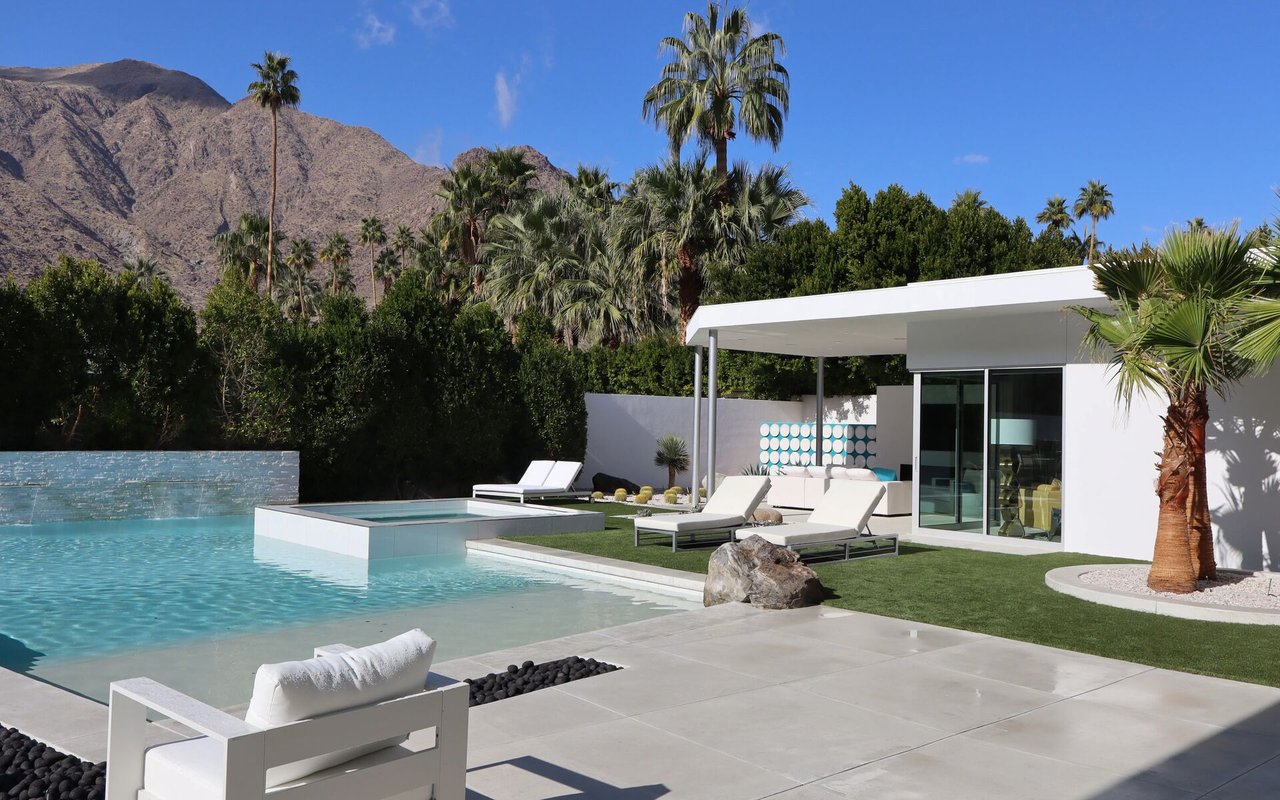
The most reliable indicator of genuine custom construction is the relationship between the home and its specific site. A custom home is designed for its lot. The orientation captures the best views from the primary living areas and the primary suite. The roof overhangs are calculated for the sun angles of that specific orientation. The entry sequence responds to the approach from the street. The indoor-outdoor connection is designed around the particular landscape of that property.
Look at how the primary living spaces relate to the outdoor areas and the views. Look at whether the window placement creates considered light conditions at different times of day or simply provides adequate illumination. Look at whether ceiling heights feel resolved or simply tall. These details reveal whether the home was designed from the inside out for a specific way of living, or assembled from a plan that functions adequately in many configurations.
What to look for in the construction
Below the finishes, several structural decisions distinguish a genuinely custom home from spec product with premium fixtures.
Structural systems
Custom homes in Paradise Valley at the upper price points often use concrete block or ICF construction rather than wood frame. These systems provide better thermal performance in the desert climate, better sound attenuation between spaces, and longer structural lifespans. The structural system choice is worth understanding before you evaluate the finishes layered on top of it
Wall thickness and mass
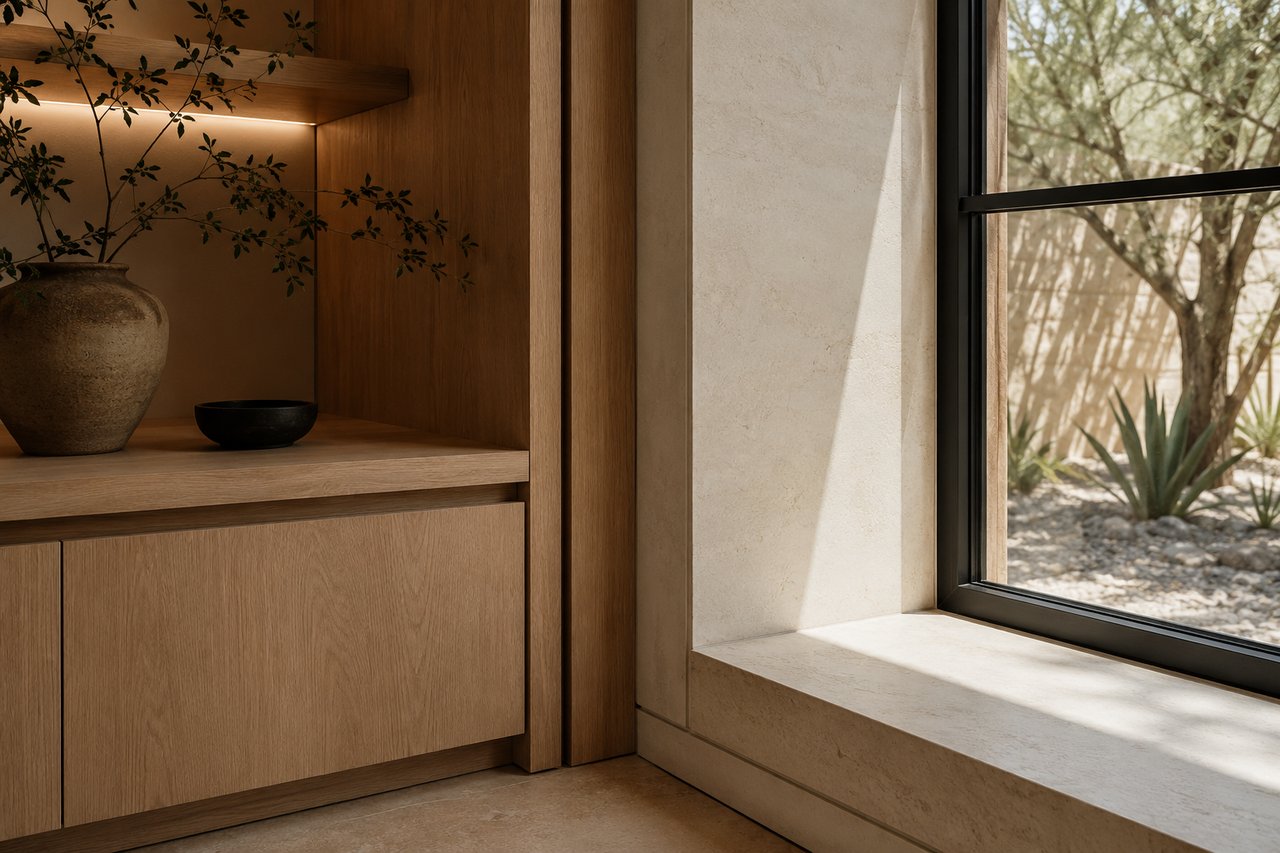
Genuine custom construction often involves thicker walls, which affects both the thermal performance of the home and the quality of the interior experience. Deep window reveals, substantial wall returns, and the sense of mass and permanence that comes from considered construction are features that photography cannot convey but a walkthrough makes immediately apparent.
Mechanical systems
A genuinely custom home typically has mechanical systems designed for that specific home's square footage, orientation, and usage patterns. HVAC zoning, radiant floor heating in select areas, whole-house filtration, and dedicated systems for wine storage or home theater are more commonly found in true custom construction than in spec product.
Millwork and cabinetry
Factory-produced cabinetry from premium manufacturers can be excellent. Site-built millwork and custom cabinetry made for specific spaces are indicators of a higher level of execution. The distinction is visible in how the millwork integrates with the architecture of the room rather than simply occupying it.
What to look for in the finishes
Finishes are the most visible and the most frequently misrepresented aspect of luxury construction. Premium appliances, imported stone, and designer fixtures are available to any builder at any price point. Their presence does not confirm genuine custom construction. Their integration with the design of the space is the more useful indicator.
Look at how stone is selected and placed across surfaces. In genuine custom construction, slabs are chosen for their specific veining patterns and oriented to create visual continuity across countertops, waterfall edges, and wall applications. In spec construction, stone is often selected from available inventory and cut to fit without the same level of compositional intention.
Look at hardware consistency across the home. Custom homes typically maintain a considered hardware language from the entry through the primary suite through secondary spaces. The quality and finish in a powder room should reflect the same standard as the primary suite. Inconsistency across spaces often signals that finishes were selected from a builder allowance rather than designed as a unified palette.
Why this matters at resale
The resale value of a custom home is supported by the same qualities that made it worth building: the relationship to its site, the integrity of the structural decisions, and the design as a unified composition. These qualities are visible to buyers who know what to look for and are registered intuitively by buyers who do not. They produce a perception of value that follows the property through subsequent sales.
Spec product with premium finishes may present beautifully at the time of sale. Finishes age. Tastes change. The underlying design does not improve with time if it was never designed for that specific site and that specific way of living. At resale, the custom home often holds its value relative to its original price more reliably than spec product at the same original price point.
Understanding what custom actually means before you buy is the most efficient way to evaluate whether you are paying for it.
Luxe Client Group serves buyers and sellers in the $1M to $10M+ market across Paradise Valley, North Scottsdale, Arcadia, Biltmore, North Central Phoenix, and surrounding submarkets. If you are evaluating a property, a listing timeline, or a market you are not yet certain about, the most useful next step is a direct conversation.